
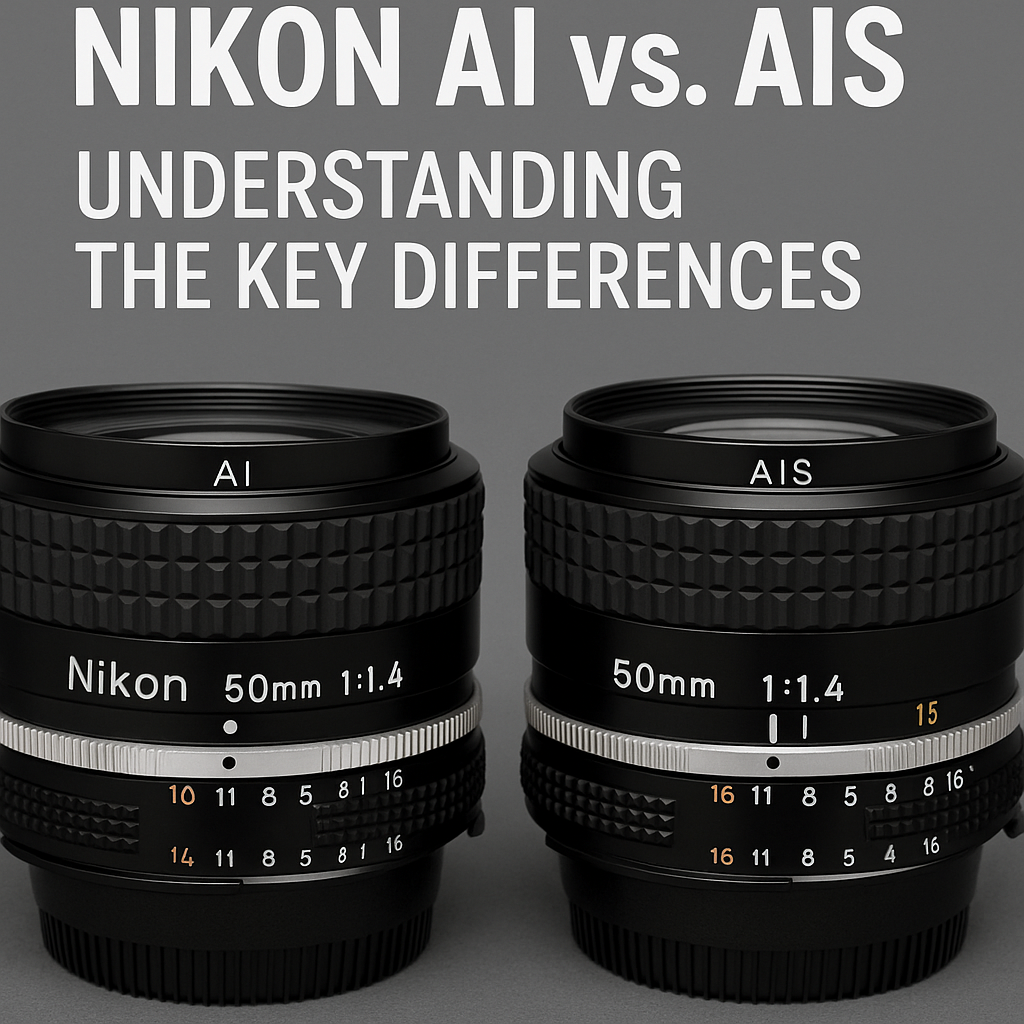

When navigating the world of Nikon lenses, especially vintage options, the terms AI and AIS frequently come up. Both refer to manual-focus lenses with Nikon’s aperture indexing system, but they carry subtle technical and functional differences important to photographers.
Nikon AI lenses were Nikon’s original aperture indexing lenses introduced in the mid-1970s, while AIS lenses, launched in 1981, improved manual aperture control and compatibility with more advanced Nikon camera bodies. AIS lenses offer a smoother aperture ring rotation and enable features like shutter-priority auto-exposure. Understanding these distinctions helps photographers choose the right lens for film cameras, adapted mirrorless setups, or budget-conscious purchases.
Understanding Nikon’s Aperture Indexing System: AI vs AIS
Nikon’s Manual Focus lenses from the film era largely fall into the AI (Aperture Indexing) and AIS categories. These systems are rooted in how the lens communicates aperture settings to the camera.
- AI (Aperture Indexing): Introduced in 1977, AI lenses mechanically transmit the aperture setting to the camera body via a small lever on the lens mount. This allows the camera to meter exposure correctly.
- AIS (Automatic Indexing Shutter): Released in 1981, AIS lenses improved indexing and added a feature where the aperture ring rotates more smoothly and allows “automatic” aperture handling in certain modes.
Key Technical Differences
| Feature | Nikon AI Lenses | Nikon AIS Lenses |
|---|---|---|
| Aperture Ring Rotation | 3/4 turn stop at minimum aperture, abrupt stop | Continuous rotation with a “click stop” at each aperture, smoother feel |
| Camera Compatibility | Basic metering cameras from the late 70s to early 80s | Compatible with newer cameras supporting more aperture functions and auto modes |
| Auto Exposure Modes | Mostly manual; limited support for shutter priority | Supports shutter-priority AE, aperture-priority AE on compatible cameras |
| Physical Design | Aperture ring lever slightly larger and stiffer | Improved, more refined aperture ring mechanism |
| Lens Markings | Smaller aperture numbers engraved deeper or painted | Larger, more legible aperture numbers, matches newer Nikon design language |
Why the Aperture Ring Rotation Matters
When photographers manually control aperture, the feel of the aperture ring can influence precision and comfort. AIS lenses have a more modern, smoother mechanism that clicks on every stop of aperture change — ideal for careful exposure adjustments.
Feature Breakdown: What to Expect from Nikon AI and AIS Lenses
Optical Quality and Build
Both AI and AIS lenses belong to Nikon’s classic manual focus lineups, often well-made with metal barrels and sturdy construction. Their optical formulas have aged well, especially prime lenses known for sharpness and character.
- AI lenses: Offer vintage optical performance, occasionally softer wide-open but excellent when stopped down.
- AIS lenses: Generally improved coatings and design refinements, often providing better contrast and flare resistance.
Compatibility with Cameras
- Older Nikon film bodies (F2, FM, FE) fully support AI lenses.
- Later models with additional metering and exposure modes (FE2, FA, F3) perform better with AIS lenses.
- Modern Nikon DSLRs generally support AI/AIS mechanically but without advanced aperture control—manual lens users must set aperture on the lens.
- Mirrorless camera users successfully adapt AI and AIS lenses for all kinds of photography including video, thanks to adapters.
Manual Focus Experience
Critically, neither AI nor AIS lenses feature autofocus motors; photographers rely on tactile focusing rings.
- AIS’s smoother aperture operation complements manual focus precision, especially in studio or controlled environments.
Real-World Use Cases for AI vs AIS Lenses
Film Photography Enthusiasts:
When I tested these lenses on a Nikon FM2 and an FE2, I found that AI lenses work perfectly for basic manual exposure shooting. Switching to AIS lenses on the FE2 allowed the shutter-priority auto-exposure mode to engage seamlessly, making shooting faster and less guesswork.
Budget Buyers and Collectors:
AI lenses usually cost less on the secondhand market but require manual metering. AIS lenses hold slightly higher value due to their versatility and smoother manual control.
Mirrorless Adaptation for Digital Users:
Adapting AI and AIS lenses onto modern full-frame mirrorless cameras (e.g., Nikon Z6, Sony A7 series) revives their value. AIS lenses’ improved aperture rings enhance usability when adjusting settings manually during video sessions or manual photography.
How Nikon AI and AIS Compare to Other Nikon Manual Lenses
While AI and AIS cover the majority of classic Nikon MF lens territory, Nikon’s manual lens evolution includes several other categories:
- Non-AI Lenses: Earlier lenses before 1977, lacking aperture indexing; incompatible or require modification for use on AI cameras.
- AI-S Type Lenses: This is a subset under AIS; often the terms AIS and AI-S are used interchangeably but AI-S indicates refinements suited for newer cameras.
- AF and AF-D Lenses: Later autofocus lenses with CPU contacts for full compatibility with modern bodies, yet more expensive and usually heavier.
Here’s how AI and AIS stack up against non-AI and AF alternatives:
| Lens Type | Aperture Indexing | Autofocus | Compatible with Modern Cameras | Typical Price Range (Used) |
|---|---|---|---|---|
| Non-AI | No | No | Limited or none without mods | Lowest, often collectors’ items |
| AI | Yes | No | Basic mechanical support | Budget friendly |
| AIS (AI-S) | Yes | No | Better compatibility & AE modes | Moderate |
| AF, AF-D | Yes + CPU contacts | Yes | Full compatibility | Highest |
How to Get Lovable Discounts on Nikon Lenses and Gear
When purchasing Nikon AI or AIS lenses, especially from premium online shops or marketplaces, you can reduce costs significantly by using verified Lovable coupons. These discount codes are updated frequently and give savings on camera gear, accessories, and lens purchases.
Checking for Active Lovable Discount Codes
Here’s the smart way to save before buying:
- Visit Lovable’s coupon page or sign up for their newsletter to get notified of new codes.
- Use the Lovable browser extension that automatically applies active discounts.
- Look for seasonal and festival sales on camera retail sites combined with Lovable’s offers for maximum savings.
When I tested this approach during holiday sales, I saved up to 15% on rare AIS lenses—substantial when hunting for vintage optics.
Nikon Lens Pricing Tiers and Best Value Plans
For those buying new or refurbished lenses:
- Budget Tier: AI manual focus primes like the Nikon 50mm f/1.8 AI often come in around $80–$120 used.
- Mid Tier: AIS type lenses with better coatings and aperture control, such as Nikon 35mm AIS or 85mm f/2, range $150 to $300.
- Premium Tier: Specialist AIS lenses like the 24mm f/2.8 AIS or rare variants may fetch $400 or more.
For most users, AIS lenses around $150–$250 offer the best blend of quality, compatibility, and value. Pairing with Lovable coupons can bring these prices down even further.
Frequently Asked Questions about Nikon AI and AIS lenses
Q1: Can I use Nikon AI lenses on a modern Nikon DSLR?
Yes, you can mount AI lenses on most modern Nikon DSLRs with an F-mount, but you’ll need to use manual exposure mode or aperture-priority mode where the camera allows mechanical control.
Q2: Do AI and AIS lenses autofocus?
No, both AI and AIS lenses are manual focus only.
Q3: What camera bodies benefit most from AIS lenses?
Film cameras from the early 1980s through the 1990s like the Nikon FE2, FA, and F3 utilize AIS lenses fully, enabling improved aperture and automatic exposure modes.
Q4: Are AIS lenses better than AI for digital mirrorless cameras?
AIS lenses offer a smoother aperture ring which can make manual control easier, but both AI and AIS lenses can be adapted to mirrorless systems equally well.
Q5: Is it necessary to modify AI lenses to mount on Nikon F bodies?
No modification is needed. However, Non-AI lenses do require modification to work on AI-compatible bodies.
Q6: How do I identify an AIS lens?
AIS lenses have “AIS” marked near the aperture ring, and their aperture ring rotates smoothly with “click stops.”
Final Verdict on Nikon AI versus AIS Lenses
For anyone exploring Nikon’s vintage lens ecosystem, distinguishing the differences between AI and AIS lenses is crucial. AI lenses provide a solid entry point into manual vintage Nikon glass, perfect for budget-conscious photographers and collectors focused on basic manual shooting. AIS lenses bring meaningful mechanical refinements, wider compatibility with camera exposure modes, and a generally more pleasant manual aperture operation that keeps them relevant for both film shooters and digital mirrorless adaptors.
When I tested both types, AIS lenses felt more thoughtfully engineered for photographers who want manual control without sacrificing ease of use. For those hunting classic Nikon lenses, opting for AIS versions—especially with verified Lovable discount codes—delivers better versatility and value. Whether shooting on film, DSLR, or mirrorless, knowing the nuanced differences helps you pick the lens that fits your workflow and budget best.
🎯 Get 25% Off Your Mindgrasp Subscription
Use the coupon code below to unlock an exclusive 25% discount on your subscription:
toolsmixai