
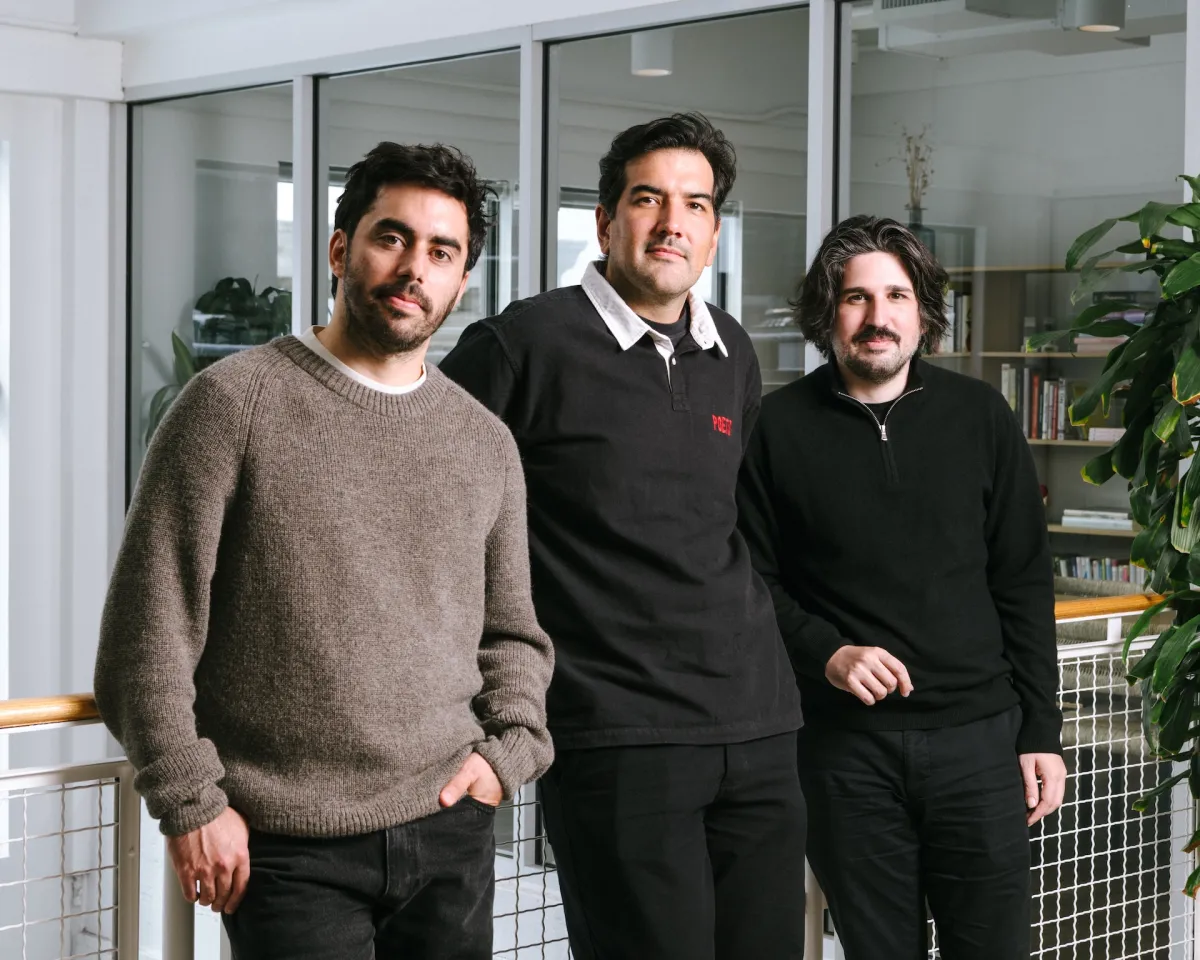

Runway, an AI video-generation startup, diverges from the usual Silicon Valley narrative. Its founders hail from Chile and Greece and met while studying at NYU’s Tisch School of the Arts, establishing the company in New York City.
Runway is being viewed by some as a potentially transformative AI player, not solely for its existing technologies but for its future aspirations.
Traditionally, the AI sector has focused on language as the core of intelligence, embodied by large language models like OpenAI’s ChatGPT and Anthropic’s Claude.
However, Runway’s founders propose a different approach. They believe the future of AI lies not in text, but in video and dynamic world models that can interpret how the world operates, beyond just human narratives. This shift, while seemingly theoretical, carries significant implications.
Anastasis Germanidis, co-founder and co-CEO, emphasized the importance of using real-world observational data in AI training as the next step in technological advancement. He asserts that the pioneering companies will be those that innovate beyond language models.
“We’re basically limited by our own grasp of reality,” Germanidis explained during an interview at Runway’s inviting office space near Union Square.
He elaborated, “Language models are derived from a variety of online sources and existing literature, processing human knowledge. To move past this, we must utilize less biased information.”
Since its inception in 2018, Runway has gained acclaim for its video generation models, topping it off with its latest release, Gen-4.5, allowing users to create editable cinematic content from text inputs.
Presently, Runway’s technology is utilized by filmmakers and advertising agencies, with contracts signed with prominent organizations such as Lionsgate and AMC Networks. Notably, its tools have been featured in the Oscar-winning film “Everything Everywhere All At Once.”
Valued at $5.3 billion, Runway reportedly added $40 million in annual recurring revenue in Q2 2026.
If Runway successfully navigates its focus on video generation to develop advanced world models, it could potentially revolutionize industries ranging from film to pharmaceuticals. Conversely, falling behind may see it eclipsed by competitors with greater financial resources, notably Google.
Taking the leap
In a recent development, Runway has ventured beyond video generation by launching its initial world model in December, with further models anticipated this year. These world models are designed to replicate environments sufficiently to anticipate their behaviors.
It isn’t the only company exploring this area; others such as Luma and World Labs are also on similar paths, while Google is advancing its own Genie world model.
A shared goal among these organizations is to create AI capable of tackling some of humanity’s toughest challenges. This is an evolution from Runway’s original focus, emerging from both technological capabilities and the founders’ willingness to adapt.
Germanidis perceives world models as vital scientific tools. By incorporating extensive sensory data into a model, it could create a digital twin of the universe for rapid experimentation. He highlights that scientific inquiry often involves delays in awaiting outcomes, suggesting that reducing these wait times could expedite advancements.
“Creating a superior scientist could significantly enhance our understanding of the world and boost our problem-solving capabilities,” Germanidis added.
The moonshot

Germanidis developed a passion for programming at the age of 11 in Athens and moved to the U.S. at 18 to pursue studies in neuroscience and film. Eventually, he pivoted back to computer science after working with various tech firms in Silicon Valley. Co-CEO Cristóbal Valenzuela began in economics, transitioned to film, and later software, while Alejandro Matamala Ortiz, also from Santiago, has a background in advertising and design management.
The trio connected in 2016 during NYU’s Interactive Communications Program, described by Valenzuela as “an art school for engineers.”
Matamala Ortiz noted they all once dreamt of being filmmakers. Thus, Runway’s initial goal was simple: Can AI enable anyone to become a filmmaker?
Following the release of their first video-generation model in February 2023 — which, compared to current offerings, was not very advanced — their mission evolved into enabling everyone to be a great filmmaker.
This growth necessitated expanding their team to 155 individuals across multiple locations, including New York, London, San Francisco, Seattle, Tel Aviv, and, most recently, Tokyo. “During this journey, we’ve realized these models can learn about the way the world functions, which can potentially impact various sectors,” he added.
This can encompass fields like robotics, drug research, and climate modeling, which have perplexed scientists for years. Last year, Runway launched a robotics division that has already achieved significant real-world applications.
Germanidis, along with many others in the field, envisions a future where a single model can integrate multiple inputs — including text, video, voice, and other sensors. He believes that the cumulative effect is the crux of this innovation.
His long-term aspirations for Runway’s technology revolve around launching biological world models for research into anti-aging.
The question of whether Runway can transition from video superiority to mastering world models remains uncertain, especially as its competitors advance. Though the company was an early adopter of AI video generation, pursuing world models presents a new challenge with formidable rivals such as Google, Meta’s Yann LeCun, and others vying for the same goal.
Kian Katanforoosh, CEO of AI benchmarking firm Workera and Stanford lecturer, highlighted that the leap from video insight to comprehensive reasoning via world models remains untested, yet not impossible. He contends that for Runway to realize its ambitions, it must secure additional resources, particularly computational power.
Runway has established partnerships with CoreWeave and Nvidia, although it has not confirmed access to dedicated cluster computing, which is crucial for training advanced models.
“How do you build a foundational model without a cluster?” Katanforoosh questioned. “I don’t think it’s feasible.”
Runway has secured $860 million in funding, including a recent $315 million investment from strategic backers like AMD Ventures and Nvidia. These figures align closely with competitors like Luma AI and World Labs, which have raised $900 million and $1.29 billion, respectively, according to PitchBook.
However, Runway faces challenges from established entities like OpenAI, which has amassed around $175 billion in funding, as noted by CEO Sam Altman, and tech giant Google, valued at nearly $5 trillion. Notably, Google is a significant rival for Runway, with its Veo model in direct competition with Runway’s video offerings, while the Genie world model targets similar future objectives.
Katanforoosh referenced OpenAI’s recent decision to shut down its video platform Sora after experiencing substantial losses, underscoring that resource availability alone doesn’t guarantee success — a notion that also applies to Runway.
He remains optimistic about Runway’s potential, citing AI audio firm ElevenLabs, which has surpassed both OpenAI and Google in certain performance metrics without their resource advantages. Katanforoosh believes Runway could adopt a similar strategy.
Valenzuela and his co-founders are aware of this comparison. He argues that their non-traditional background provides an advantage, allowing for diverse perspectives. Being unaffiliated with Silicon Valley norms pushed them to be resourceful and prioritize early revenue generation.
According to Michelle Kwon, Runway’s COO, the company isn’t rushing to seek additional funding as it scales up its computational requirements.
“Their distinctive backgrounds have propelled them to innovate quickly and accurately, fostering a culture of rapid progress,” said early investor Michael Dempsey, managing partner at Compound.
Valenzuela emphasizes that this unique culture shapes their worldview. In his rare moments of free time, he immerses himself in literature, including the works of Chilean poet Nicanor Parra, whom he views as a counterpoint to Pablo Neruda, advocating that poetry should be accessible to the masses rather than confined by convention.
“Rules are merely conventions invented by others,” Valenzuela said. “This philosophy drives our approach at Runway, challenging the notion that Silicon Valley is the epicenter of innovation. Those standards are just arbitrary; we aim to redefine the rules.”
When you purchase through links in our articles, we may earn a small commission. This doesn’t affect our editorial independence.
#Runway #started #helping #filmmakers #beat #Google